DEFINITIONAL PILLAR · GENERATIVE ENGINE OPTIMIZATION
What Is Generative Engine Optimization (GEO)? — The Complete Guide for eCommerce Brands
Generative Engine Optimization (GEO) is the practice of structuring content, technical signals, and authority so that AI-powered platforms — ChatGPT, Perplexity AI, Google AI Overviews, and Gemini — extract and cite your brand when generating answers to user queries. Ilon SEO Consulting implements GEO for eCommerce brands as a specialized discipline distinct from, but built on, traditional SEO.
GEO is also called Answer Engine Optimization (AEO). Both terms describe the same discipline. This guide uses both interchangeably.
The difference
GEO vs. AEO vs. SEO — What's the Difference and Why eCommerce Brands Need All Three
SEO, AEO, and GEO are not competing disciplines — they are three layers of the same visibility stack. SEO targets traditional search engine rankings. AEO and GEO target AI-generated answer citations. The technical foundation is shared; the optimization targets differ.
| Dimension | SEO | AEO | GEO |
|---|---|---|---|
| Definition | Optimize for ranked positions in Google and Bing | Optimize for cited answers in AI-powered search tools | Optimize for cited answers specifically in LLM platforms |
| Primary Platform | Google, Bing, Yahoo | Google AI Overviews, Bing Copilot | ChatGPT, Gemini, Claude, Perplexity |
| Trigger | User types a keyword query | User asks a question in search | User asks a conversational question in an LLM |
| Output | A ranked list of links | A synthesized answer with source citations | A generated response with inline citations |
| Key Signal | Keyword relevance + domain authority + technical health | E-E-A-T + structured data + entity clarity | Entity recognition + editorial citation authority + training data presence |
| Measurement | Rankings, organic traffic | AI Overview citation rate | LLM citation frequency (AI Visibility Score) |
| Content Format | Keyword-optimized pages | Answer-forward, structured, entity-clear | Answer-forward, entity-defined, citation-anchor |
The practical implication: a brand that invests in SEO alone captures traditional search traffic. A brand that adds AEO and GEO captures the AI-generated product-discovery channel — where high-consideration buyers increasingly make first brand contact.
How it works
How Generative Engine Optimization Works — The Technical and Content Foundations
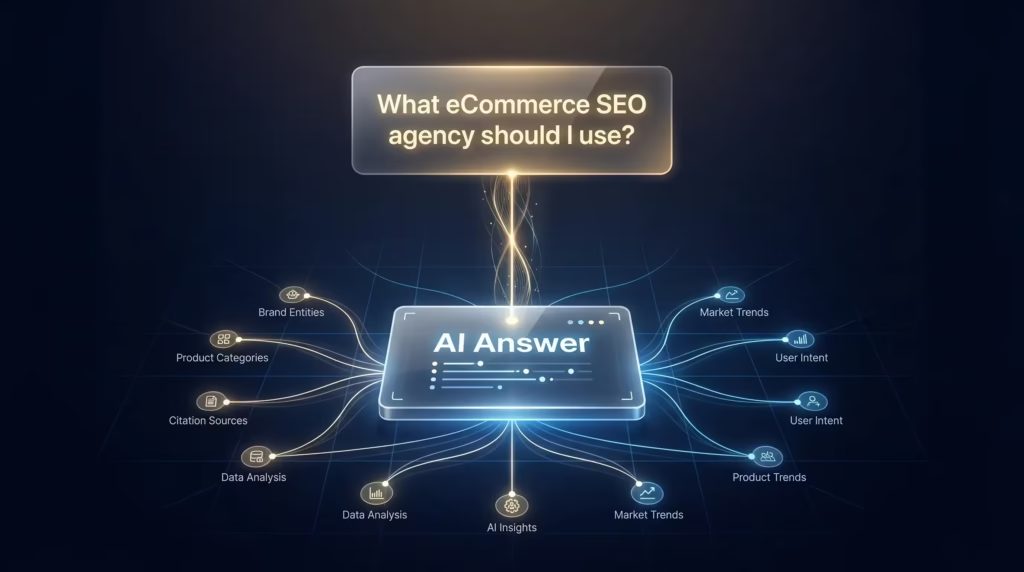
GEO works by ensuring three things simultaneously: AI crawlers can access your content, AI models can recognize your brand as a named entity, and authoritative third-party sources cite your brand in the training and retrieval data AI platforms reference.
Foundation 1 — AI Crawlability
AI platforms deploy their own crawlers: GPTBot (OpenAI/ChatGPT), Google-Extended (AI Overviews + Gemini), PerplexityBot, and ClaudeBot (Anthropic). If any are blocked in robots.txt — intentionally or by default — the brand is invisible to that platform regardless of content quality.
Foundation 2 — Entity Clarity
AI models operate on entity recognition, not keyword matching. The model must know the brand exists as a distinct entity, associate it with the correct product categories, and have enough structured information to generate an accurate citation. Entity-First Content Architecture builds this through structured definitions, consistent schema, and clear semantic relationships.
Foundation 3 — Citation Authority
AI models draw recommendations from training data and retrieval-augmented generation (RAG). Both weight editorial authority — brands cited in trusted publications are cited by AI tools. Citation-Based PR targets the specific publications that appear in AI training data and RAG retrieval for product category queries.
Implementation
How Ilon SEO Consulting Implements GEO for eCommerce SMBs
Ilon implements GEO through the same four-phase framework used across all engagements — with the AI Visibility Score as the measurement system tracking progress at every stage.
| Phase | Timeline | Measurable Outcome |
|---|---|---|
| Phase 1 — GEO Audit | Days 1–7 | AI Visibility Score baseline established |
| Phase 2 — Technical Foundation | Weeks 1–4 | AI crawlers confirmed active; schema validated |
| Phase 3 — Content Architecture | Weeks 4–12 | AI citation rate begins improving; Score moves to 30–50 |
| Phase 4 — Citation-Based PR | Months 3–6 | Citation authority compounds; Score targets 60+ |
Why eCommerce
GEO for eCommerce — Why Product-Selling Brands Are the Highest-Priority Use Case
GEO is most valuable for brands where buyers research before purchasing — and where the AI tool’s recommendation directly influences the purchase decision. eCommerce brands selling considered products are the clearest use case.
- Buyers researching considered purchases increasingly use ChatGPT and Perplexity AI as their first research tool — before visiting any brand website.
- The AI tool's recommendation acts as a trusted endorsement — brands cited receive the implicit authority of the platform's apparent confidence.
- Most eCommerce SMBs have not yet invested in GEO — creating a window of competitive opportunity early movers will close.
- The same foundations that drive GEO also drive Google SEO — making GEO investment doubly efficient.
FAQ
Frequently Asked Questions About Generative Engine Optimization
Is Generative Engine Optimization same as Answer Engine Optimization?
Yes. GEO and AEO describe the same discipline from slightly different angles. GEO emphasizes large language model platforms (ChatGPT, Gemini, Claude). AEO emphasizes AI-powered search tools (Google AI Overviews, Bing Copilot, Perplexity AI). Ilon uses both terms interchangeably because the implementation methodology is identical.
Does GEO require a different technical work than standard SEO?
GEO requires most of the same foundations as SEO. The key additions: (1) confirming AI-specific crawlers are not blocked, (2) implementing entity-defining schema (DefinedTerm, Brand, Organization) that helps AI models recognize brand entities, and (3) structuring content in answer-forward formats AI extraction favors over keyword-dense paragraphs.
How quickly can GEO improve a brand's citation rate
Based on Ilon client data, eCommerce brands completing Phase 1 and 2 (technical fixes + entity clarity) see measurable improvements within 30–60 days. Full Phase 3 and 4 implementation produces the most significant jumps at the 60–90-day mark and continues through month six.
Does GEO work fro brands outside Toronto and Canada?
Yes. Ilon serves eCommerce SMBs across Canada and the United States. GEO is platform-agnostic — ChatGPT, Perplexity AI, and Gemini operate globally, and the methodology is the same regardless of the brand’s geographic market.