What Is AEO (Answer Engine Optimization), and Why Should eCommerce Brands Care in 2026?
AEO, or Answer Engine Optimization, is the practice of structuring your content so AI systems like ChatGPT, Gemini, and Perplexity are more likely to quote you as the answer. In other words, it’s SEO, but you’re writing for robots that write for humans. I know. Meta.
Here’s the thing. I’ve been doing SEO for over a decade, and the shift to AI-generated answers is the biggest change I’ve seen since Google killed keyword stuffing. For eCommerce brands, it’s the difference between holding real AI Share of Voice across ChatGPT, Perplexity, and Google AI Overviews, or being the brand nobody’s assistant has heard of. So let’s get into it.
What is AEO, in plain English?
AEO is the discipline of writing and structuring content so AI answer engines can lift it, cite it, or quote it directly. Instead of chasing a blue link in position one, you’re chasing the sentence an AI actually uses when someone asks “what’s the best espresso machine under $500.”
Key components of AEO:
- Answer-first formatting: the first sentence under a heading directly answers the question
- Structured data: Product, FAQ, and Review schema that machines can parse instantly
- Entity clarity: your brand, product, and category are unambiguous, not implied
- Extractable chunks: short, self-contained paragraphs that make sense pulled out of context
How does AI search actually decide what to quote?
AI systems decide what to quote by scanning for content that answers a specific query cleanly, backs itself with credible signals, and is structured in a way that’s easy to lift without rewriting. Think of it like a hiring manager skimming forty resumes. The one written in bullet points with clear numbers gets read first.
A pattern I’ve seen repeat itself across audits: pages stuffed with adjectives (“amazing,” “premium,” “game-changing”) get skipped, while pages with hard numbers and direct comparisons get cited. I ran into this exact issue with a home espresso client whose product pages read like poetry and performed like it too, beautifully, to no one.
Is AEO replacing SEO, or is that a false alarm?
AEO is not replacing SEO. It’s a layer on top of it. Think of traditional SEO as building a road. AEO is putting up the road signs so AI can read them. You still need the road.
| Option | Best for | Key difference |
|---|---|---|
| Traditional SEO | Ranking pages and earning organic clicks | Measured by Web Visibility and Search Demand |
| AEO | Getting quoted or linked inside an AI answer | Measured by Citations and Cited Pages |
| Doing neither | Nothing, honestly | You disappear from both surfaces |
Ahrefs data shows that roughly 96.55% of pages get zero organic traffic from Google, which tells you most sites are already failing at the traditional layer, let alone the AI one. Skipping AEO on top of that just compounds the problem.
How do I start doing AEO on my product and category pages?
- Rewrite your top 10 revenue pages first. Add a direct, one-sentence answer to the primary question a buyer would ask about that product.
- Add FAQ schema to PDPs and category pages. Answer the three questions buyers actually type into Google or ChatGPT about that product.
- Cut adjective-heavy copy. Replace “durable and reliable” with the actual spec: “rated for 500 charge cycles.”
- Name your entities clearly. State your brand, product line, and category explicitly instead of relying on pronouns and implied context.
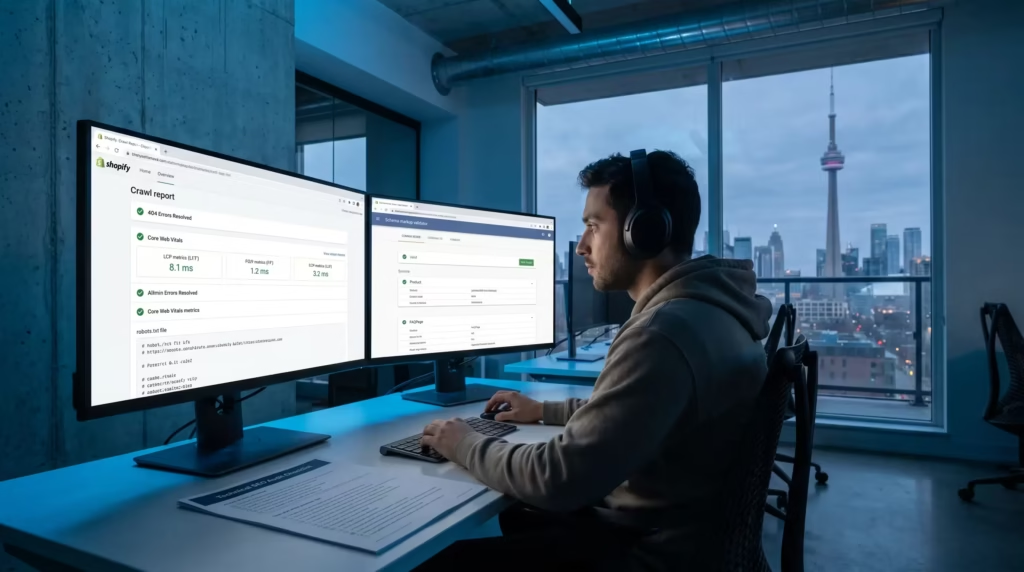
- Check crawl access. Confirm GPTBot, PerplexityBot, and other AI crawlers aren’t blocked in robots.txt. This is the first thing I check in any technical SEO audit for eCommerce sites, because a blocked crawler cancels out everything downstream.
Failon’s Tip: Open Search Console, pull your top 20 organic pages, and rewrite just the first sentence under each H2 to directly answer the heading. Takes under five minutes per page and it’s the single highest-leverage AEO fix I know.
How do I track AI Share of Voice without guessing?
You track it through prompt tracking, the practice of building a fixed set of real buyer prompts and monitoring which brands and URLs each AI surface returns over time. Without a tracked prompt set, every AI visibility claim is a guess dressed up as data.
| Metric | What it measures | What good looks like |
|---|---|---|
| AI Share of Voice | % of tracked prompts naming your brand vs competitors | Steady growth against a fixed competitor set |
| Mentions | Times your brand is named, linked or not | Rising across at least three surfaces |
| Citations | Times an AI answer links directly to your domain | A smaller number than Mentions, and more valuable |
| Cited Pages | The specific URLs AI systems pull from | Expanding beyond just your homepage |
Track prompts across at least four surfaces, ChatGPT, AIO, AIM, and Perplexity, reviewed monthly. Pair this AI layer with your classic Web Visibility and Search Demand data so you’re seeing the whole picture, not just the shiny new metric. Our keyword research process now builds these prompt sets alongside traditional keyword maps for every new client.
What’s the difference between a Mention and a Citation, and which one pays the bills?
A Mention is any time an AI answer names your brand in the response text. A Citation is any time that answer links to or sources a page on your domain. They are not the same thing, and confusing them is one of the fastest ways to misread a report.
Citations tend to pay the bills more directly because they carry a link, which means a click is still possible even in an AI-first world. Mentions build brand recall without traffic. You want both, but if you’re prioritizing, chase Cited Pages first, since that tells you which content is actually extractable.
What do most eCommerce stores get wrong with AEO?
Most stores get wrong the assumption that adding schema alone will fix their AI visibility. In an Ilon SEO Consulting audit of 40 DTC eCommerce sites, tracked across 60 buyer prompts on ChatGPT, Perplexity, AIO, and Copilot over 90 days, here’s what we found holding brands back:
Ilon SEO Consulting Audit Finding, DTC eCommerce (2026)
| Issue | % of Sites Affected |
|---|---|
| AI crawlers blocked or partially blocked in robots.txt | 34% |
| No Product schema on primary PDPs | 72% |
| Collection pages with no descriptive intro copy | 68% |
| FAQ schema missing on key landing pages | 81% |
| No author or brand credential signals on content pages | 77% |
| No prompt tracking in place of any kind | 88% |
| Fewer than 5 Cited Pages across all AI surfaces | 64% |
Schema fixed only 34% of the underlying problem on its own. The bigger gap was content structure and missing prompt tracking, meaning most of these brands genuinely didn’t know where they stood.
A client in the marine and boating parts space had immaculate schema and still held a 2% AI Share of Voice, because their product copy never actually answered a buyer’s question in plain sentences. We rewrote the top 15 PDPs answer-first, and Citations across Perplexity and ChatGPT went from 3 to 21 over the following quarter.
Frequently Asked Questions
Q: Is AEO the same thing as SEO? A: No. AEO is a layer on top of SEO focused specifically on earning citations and mentions inside AI answers, while SEO focuses on ranking and organic clicks.
Q: Does AEO still matter in 2026, or has this already peaked? A: It still matters and is growing. Google AI Overviews and AI Mode continue expanding coverage of search queries, which increases the share of buyer questions resolved inside AI answers rather than on the SERP.
Q: Should I focus on ChatGPT or Perplexity first? A: Start with Perplexity for the fastest early signal, since it has the heaviest citation density of any major surface, then expand tracking to ChatGPT and AIO.
Q: How do I measure AI Share of Voice if I’ve never tracked it before? A: Build a set of at least 40 to 60 real buyer prompts, run them across ChatGPT, Perplexity, AIO, and Copilot monthly, and record how often your brand appears against competitors.
Q: What happens if I ignore AEO entirely? A: You risk becoming invisible on the growing share of searches that resolve inside an AI answer, even if your traditional Web Visibility stays strong.
Q: Do I need to redo all my existing product pages for AEO? A: No. Prioritize your top-revenue pages first, then work down the list based on Search Demand and current Cited Pages performance.
If you want a clear read on where your store stands right now, get your free AI Visibility Score and I’ll walk you through exactly what’s holding your Citations back.
Written by Failon OB, founder of Ilon SEO Consulting and an SEO Specialist with more than a decade of experience in SEO, AEO, and GEO. I help eCommerce brands earn AI Share of Voice, Mentions, and Citations across ChatGPT, Google AI Overviews, AI Mode, Gemini, Perplexity, Copilot, and Claude, alongside the Web Visibility and YouTube Visibility that still drive revenue. Based in Toronto, ON, working with product-selling brands across Canada and the United States. ilonseoconsulting.com | Get your free AI Visibility Score | Connect on LinkedIn